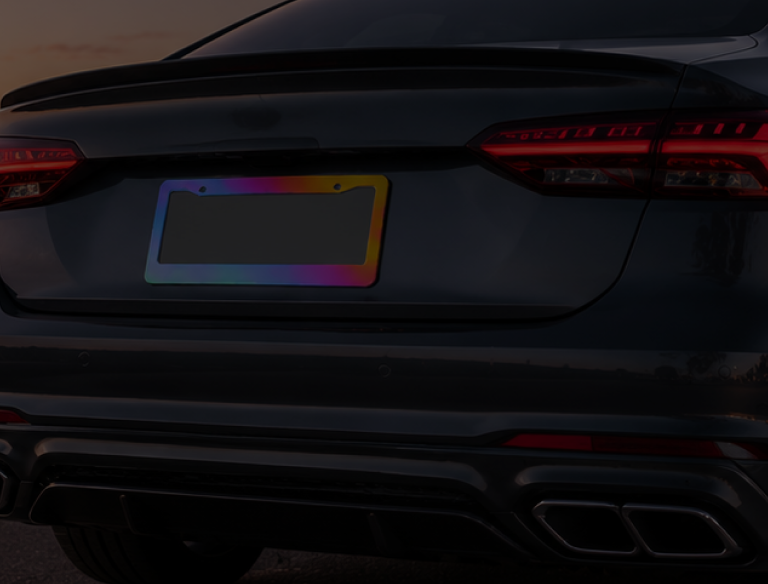
When browsing for an upgraded license plate frame, many car owners focus purely on surface aesthetics—whether the finish is a sleek matte black or a brilliant mirror gloss. However, the true durability and lifespan of a metal frame are determined during its very first manufacturing stage: Industrial Metal Stamping (Pressing).
Metal stamping is the precision engineering process where flat metal sheets are fed into heavy-duty press machinery and transformed into rigid, contoured, three-dimensional automotive components. A license plate frame is subjected to extreme environments; it must endure intense highway wind resistance, continuous vehicle engine vibrations, and the harsh, automated brushes of a car wash. If a frame is stamped using subpar machinery or uncalibrated tooling molds, it will quickly warp, rattle against your bumper, or fail to align with your vehicle's mounting holes.
At our advanced manufacturing facility, we utilize state-of-the-art stamping technologies to manipulate three of the industry's most popular metals: Aluminum Alloy, Grade 201 Stainless Steel, and Heavy-Duty Iron. By understanding the unique molecular characteristics of each metal, we engineer frames with unmatched structural integrity and a perfect vehicular fit.
Why Precision Stamping Matters: The Backbone of Frame Quality
For an accessory that secures your official license plate, precision in the stamping department is non-negotiable. Our rigorous pressing processes ensure several key physical advantages:
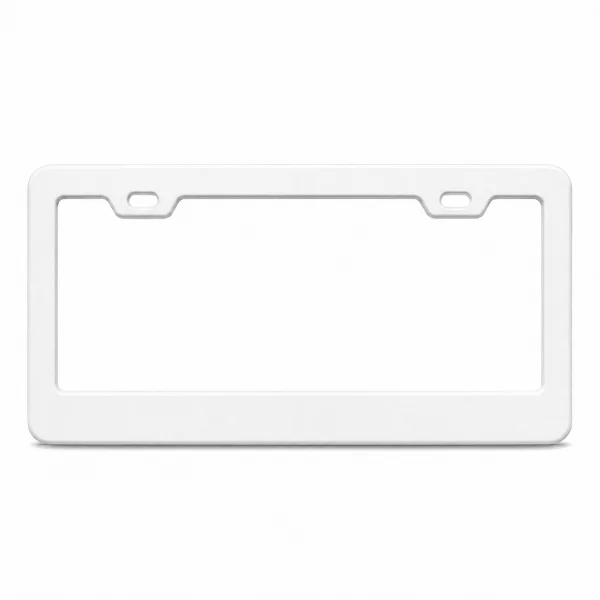
• Absolute Dimensional Accuracy: Overseas automotive markets have strict, standardized dimensions for license plate configurations (such as the standard US 12x6-inch plate or Euro-spec plates). Our precision-machined molds ensure that the inner perimeter, outer borders, and the four pre-drilled mounting holes align 100% perfectly with your vehicle's bumper and your license plate, eliminating any frustrating installation errors.
• Unyielding Structural Integrity: High-quality stamping actually alters the metal grain structure, reinforcing its resistance to bending and warping. Our frames maintain a completely uniform thickness throughout the entire profile, preventing weak points that could buckle under physical stress.
• Perfect Edge Flatness (Zero-Rattle Performance): Cheap stamping often causes sheet metal to cup or twist, resulting in a slightly warped frame. When mounted, a warped frame vibrates against the vehicle's bodywork, creating annoying noises and scratching the paint. Our precise flattening and stamping cycles guarantee an incredibly flat profile that sits flush against your car.
Material-Specific Stamping Guide: Mastering Aluminum, 201 Stainless Steel, and Iron
Different metals exhibit vastly different levels of hardness, elasticity, and ductility. A stamp setting that works perfectly for a soft metal will crack a harder alloy. Here is how we customize our industrial stamping lines for each core material:
Aluminum Alloy: Lightweight Precision and Stress-Crack Prevention
Aluminum alloy is highly favored in the automotive community because it is incredibly lightweight and inherently rust-resistant. However, aluminum has lower ductility than iron, meaning it is highly sensitive to stress. If it is stamped too quickly or bent at an aggressive angle, micro-fractures and stress-cracking will develop along the inner corners and flanges of the frame.
• The Process: To master aluminum stamping, we utilize automated mechanical presses running at a highly controlled, moderate stroke speed. We design our stamping molds with precise, calculated bend radiuses. By using specialized, non-staining aluminum stamping lubricants, we reduce friction and ensure the metal flows smoothly into the mold shape. This results in a structurally sound aluminum frame with beautifully smooth corners and zero internal structural defects.
Grade 201 Stainless Steel: High-Tonnage Defeat of Extreme Hardness
Grade 201 stainless steel is chosen for its incredible impact resistance, tensile strength, and high-end luster. However, due to its high manganese content, 201 stainless steel is exceptionally hard and exhibits massive "springback". Springback is the tendency of a metal sheet to partially return to its flat shape after the stamping press releases. Furthermore, stamping 201 stainless steel subjects manufacturing molds to extreme wear and tear.
• The Process: Defeating the tough nature of 201 stainless steel requires heavy industrial firepower. We deploy high-tonnage hydraulic and high-speed precision presses to stamp our stainless steel frames. Our engineering team utilizes ultra-hard, nitride-treated tungsten carbide molds that are specifically engineered with "springback compensation." The molds are designed to over-bend the metal by a microscopic fraction, so that when the steel snaps back upon release, it rests at the exact, desired geometrical angle. This delivers a frame with razor-sharp, aggressive design lines and unparalleled strength.
Iron and Carbon Steel: High-Efficiency Consistency and Flattening Cycles
Iron and carbon steel are the traditional powerhouses of the automotive accessory industry, offering great weight, impact resistance, and cost efficiency. When raw sheets of iron are stamped out by industrial presses, the primary challenge is maintaining absolute flatness, as the sheer force of punching out the large center window of the frame can release internal stresses, causing the remaining thin border to warp.
• The Process: We utilize automated Progressive Die Stamping for our iron license plate frames. In a progressive line, the iron sheet is fed through a sequence of stations within a single die. The machine performs punching, cutting, and flanging simultaneously in consecutive steps. To counter any stress-induced warping, we incorporate a dedicated multi-roller leveling and flattening stage directly into the stamping sequence. This ensures that the finished iron frames exit the production line perfectly flat, providing a uniform canvas for subsequent anti-corrosion coatings.
Advanced Machinery & Technology: Engineering Consistency
To eliminate the human errors associated with manual single-stage pressing, our factory invests in automated, digital production technologies:
• Integrated Progressive Dies: By combining multiple manufacturing steps into one automated die system, we achieve absolute consistency across production runs. The 10,000th frame manufactured has the exact same dimensions, hole placements, and structural strength as the very first prototype.
• Digital Tonnage and Stroke Management: Our advanced stamping lines feature real-time pressure monitoring. The machinery automatically calibrates its downward force based on the material thickness, ensuring that the metal molecule structure is compressed safely without creating hidden stress points.
Quality Control: The Blueprint Compliance Test
Every batch of stamped metal license plate frames must survive a strict, zero-tolerance Quality Assurance (QA) protocol before moving to the polishing and surface treatment departments:
1. Go/No-Go Gauge Inspection: Inspectors place randomly sampled stamped frames into precision-machined steel master gauges. The frame must slide effortlessly into the gauge, and all screw holes must line up with 100% accuracy. If a frame fails by even a fraction of a millimeter, the stamping line is stopped and recalibrated.
2. Marble Platform Flatness Test: Stamped frames are placed onto highly calibrated, perfectly level marble inspection tables. A feeler gauge is used to measure any microscopic gaps underneath the edges. This ensures that no warped frames make it to the packaging line, eliminating bumper rattle for the end-user.
Uncompromising Strength from the Start
A truly premium license plate frame is built from the inside out. By combining high-tonnage machinery, advanced progressive tooling, and material-specific engineering for aluminum, 201 stainless steel, and iron, we ensure that every frame leaving our factory floor boasts impeccable structural strength and a perfect vehicular fit. When you install our license plate frames, you are installing a piece of heavy-duty automotive hardware engineered to endure the open road.