For drivers living in cold-weather regions across North America and Europe, winter driving demands serious vehicle preparation. As the snow season approaches, you likely switch to winter tires, upgrade to heavy-duty rubber floor mats, and ensure your windshield washer fluid is rated for sub-zero temperatures. However, there is one critical area of the vehicle that most owners completely neglect until irreversible damage has already occurred: the rear license plate bracket.
During winter, highway departments spray thousands of tons of chemical de-icers, liquid brines, and coarse rock salt onto public roads to prevent ice formation and ensure safety. While essential for traction, this chemical mixture creates a highly corrosive environment for automotive components.
A standard vehicle license plate, along with ordinary metal or rigid plastic aftermarket frames, sits directly in the line of fire for rear-wheel tire spray. If you leave your plate unprotected on salt-treated winter roads, you are actively inviting rust, structural paint failure, and brittle cracking to take over your vehicle’s rear fascia. In this comprehensive cold-weather engineering guide, we will break down the precise chemistry of how winter road salt destroys traditional license plate hardware and explain why switching to an automotive-grade silicone frame is the smartest, most durable defense for your vehicle.
The Chemistry of Corrosion: How Road Salt Destroys Hardware
To understand why traditional materials fail so rapidly in freezing temperatures, it helps to examine the basic science behind winter road treatments. Rock salt consists primarily of sodium chloride, while advanced liquid brines often contain magnesium chloride or calcium chloride. These chemical compounds are exceptionally hygroscopic, meaning they actively attract and retain ambient moisture from the air.
When these dissolved salts coat a traditional metallic plate or frame, they accelerate a devastating electrochemical process:
Galvanic Corrosion Acceleration
Most aftermarket metallic frames are made from zinc alloys, stamped aluminum, or chromed steel, fastened with generic iron bolts. When salt water seeps into the tight interfaces between these mismatched metals, it acts as an aggressive electrolyte. This triggers rapid galvanic corrosion, causing the metals to chemically bind to one another. The result is a rust lock that permanently fuses your mounting screws, making it nearly impossible to remove the plate in the spring without snapping the hardware inside your bumper.
The Bleeding Rust Aesthetic Damage
As standard steel screws oxidize under the influence of winter salt, the resulting iron oxide liquefies during winter thaws. This highly acidic, rusty brown liquid slowly drips down from the screw holes, running across the face of your frame and leaving permanent, unsightly orange streaks burned directly into your vehicle's factory paint clear coat.
Plastic Embrittlement and Thermal Cracking
Some drivers assume that switching to plastic frames avoids rust entirely. However, standard ABS or promotional plastic brackets react poorly to extreme cold. When temperatures drop below freezing, low-grade polymers lose their structural flexibility and enter a highly brittle state. When subjected to sub-zero temperatures combined with the physical shock of automatic car wash brushes or heavy chunks of flying highway ice, cheap plastic frames easily develop hairline stress fractures and crack completely in half around the mounting tabs.
The Engineering Advantage of Automotive-Grade Silicone
To survive harsh winter climates without degrading, an automotive accessory must possess three fundamental material properties: complete chemical inertness, excellent thermal stability, and flexible physical isolation. This is precisely why high-quality silicone has become the modern industry benchmark for cold-weather durability.
Unlike metal which oxidizes, or plastic which hardens and cracks, premium silicone provides distinct engineering advantages that insulate your vehicle from winter hazards:
100% Chemical Immunity to Salts and Brines
Silicone is a synthetic polymer featuring a highly stable silicon-oxygen backbone. This unique molecular architecture is entirely impervious to chemical attack from sodium chloride, calcium chloride, and aggressive industrial liquid brines. No matter how much concentrated road salt accumulates on its surface, silicone will never oxidize, rust, tarnish, or suffer from surface pitting, maintaining a clean, deep-matte factory finish all winter long.
Flawless Flexibility in Extreme Cold
While low-grade plastics become brittle and shatter in freezing weather, high-grade automotive silicone maintains its elastomeric flexibility at temperatures well below -40°F (-40°C). It remains soft, pliable, and shock-absorbent through the harshest winter blizzards. This flexibility allows the frame to easily absorb the physical impact of frozen snow chunks, high-pressure car wash sprays, and trunk slams without cracking.
Snug, Wrap-Around Protective Enclosure
Traditional rigid frames sit loosely on top of the license plate, leaving an open physical gap where wet road salt and mud can settle and sit stagnant against your vehicle’s clear coat for months. A premium silicone frame functions like a form-fitting phone case, completely wrapping around the sharp, galvanized metal edges of the registration plate. This creates a soft, sealed cushion barrier that prevents the metal plate from vibrating and scratching your paint, completely blocking abrasive grit from grinding away your vehicle's finish.
Smart Winter Design: The Importance of Integrated Drainage
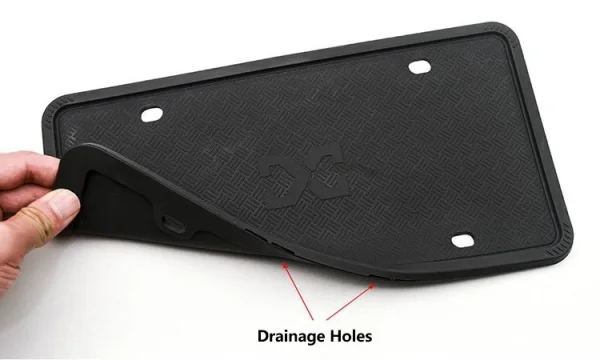
When choosing a silicone frame for severe winter environments, product geometry is just as important as material selection. Low-quality silicone brackets often copy simple shapes, forming a solid cup that traps water inside the lower lip. When that trapped water freezes, it expands, warping the plate and stressing the hardware.
High-quality silicone frames are engineered with integrated bottom drainage slots. These precision-cut channels utilize basic physics to ensure absolute cold-weather reliability:
- Gravity-Assisted Flushing: As snow melts or as you drive through a winter car wash, water instantly passes through the frame, draining out the bottom rather than sitting stagnant.
- Preventing Ice Expansion: By continuously clearing moisture, the frame prevents ice from forming inside the housing, ensuring the plate always lays perfectly flat and secure.
Winter Maintenance Check
Before the first major blizzard hits your region, take ten minutes to inspect your vehicle's rear plates and follow these cold-weather survival tips:
- Remove old promotional plastic frames before sub-zero temperatures cause them to crack.
- Inspect factory mounting holes for early signs of salt-induced rust.
- Replace degraded factory bolts with marine-grade stainless steel or nylon hardware.
- Apply a microscopic layer of anti-seize lubricant inside the receiving threads.
Keeping the Stance Clean
Ultimately, protecting your vehicle's rear styling through the winter months comes down to a matter of materials science. Eliminating rigid, moisture-trapping brackets from your tailgate is a small detail that makes a massive difference in how your vehicle resists environmental wear. Shifting to flexible, automotive-grade silicone frames provides an all-in-one cushion barrier that naturally repels road brine, drains moisture, and dampens road shock, ensuring your vehicle's paint and registration plate remain perfectly clean, safe, and rust-free through every harsh winter freeze.